When Permanent Adaptations Aren’t an Option
Accessible Bathing Solutions for People Living in Rented Homes
For thousands of disabled and older people across the UK, remaining independent at home depends on having access to safe bathing facilities. Yet for those living in rented accommodation, obtaining suitable bathroom adaptations can be far more complicated than simply identifying the need.
While many landlords are supportive of adaptations that enable tenants to remain safely in their homes, others are understandably hesitant about permanent structural alterations.
Concerns around property value, future lettings, reinstatement costs or the suitability of adaptations for subsequent tenants can all delay or prevent essential works from going ahead.
For Occupational Therapists(OTs), Disabled Facilities Grant (DFG) teams and housing professionals, this can create a frustrating impasse. The need is clear, funding may even be available, but obtaining landlord consent becomes the biggest obstacle.
Fortunately, permanent bathroom alterations are no longer the only solution.
The Challenge of Adapting Rental Properties
Approximately one in five households in England now lives in privately rented accommodation, while many more rent from housing associations or local authorities. As the population ages and more people choose or need to rent later in life, demand for accessible housing within the rental sector continues to increase.
Traditional wet room conversions typically involve:
- Removing existing bathrooms
- Altering drainage
- Waterproofing floors and walls
- Installing level-access shower systems
- Structural modifications
Although highly effective, these adaptations permanently alter the property. Even where legislation requires landlords to consider reasonable adjustments, negotiations over responsibility, reinstatement and long-term implications can delay projects by weeks or months.
For someone unable to shower safely, every week matters.
Poor access to washing facilities can lead to declining personal hygiene, increased falls risk, skin problems, infections, reduced confidence and greater reliance on carers. Many people begin avoiding bathing altogether because the process has become too difficult or dangerous.
When Time Matters
Many housing adaptations are required following life-changing events such as:
- Stroke
- Spinal cord injury
- Motor Neurone Disease
- Multiple Sclerosis
- Parkinson’s disease
- Major trauma
- Hospital discharge after surgery
These conditions rarely wait for lengthy approval processes.
The NHS continues to place significant emphasis on Home First and timely discharge, recognising that prolonged hospital stays can lead to muscle loss, reduced independence and increased risk of complications. Delays caused by inaccessible bathrooms may contribute unnecessarily to extended admissions or temporary placements in rehabilitation units or care homes.
For people living in rented accommodation, finding an alternative solution that avoids major building works can therefore have significant clinical, financial and emotional benefits.
A Different Approach: Temporary Modular Wet rooms
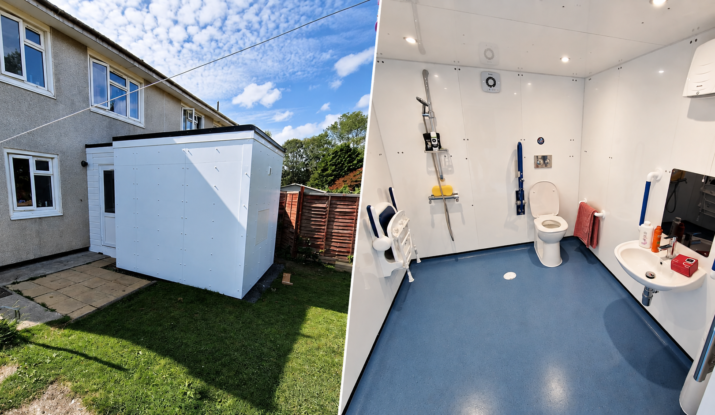
Rather than adapting the building itself, modular temporary wet rooms such as the WashPod™ range from Dignity Access provide a fully accessible showering environment that can often be installed within days.
WashPods™ are pre-assembled off-site before delivery, so that they can be carried through the property in sections making installation considerably quicker than traditional building works, offering greater flexibility and requiring minimal disruption to the existing property.
Depending on the property layout, models can be installed:
- Inside the home
- As an extension through an external wall
- Within the garage if more appropriate
Most importantly, the original bathroom remains largely untouched.
When the adaptation is no longer required, the WashPod™ can be removed and the property reinstated with minimal remedial work.
For landlords, this significantly reduces many of the concerns associated with permanent structural alterations.
Benefits for Landlords
From a landlord’s perspective, temporary modular solutions offer several advantages.
Most importantly, they preserve the long-term flexibility of the property while enabling tenants with disabilities to remain safely in their home.
Instead of permanently converting a family bathroom into a specialist wet room that may not suit future occupants, landlords can accommodate current accessibility needs without fundamentally changing the property.
This can be particularly valuable where properties are:
- Listed buildings
- High-value rental homes
- Leasehold properties
- Subject to planning restrictions
- Intended for future resale
Knowing that the property can be restored once the tenant moves or their circumstances change often makes discussions around consent significantly easier.
Supporting Better Outcomes for OTs
OTs frequently balance clinical need with practical realities. A recommendation is only successful if it can actually be delivered.
Temporary modular wet rooms provide another option when traditional adaptations become stalled because of landlord objections, lengthy construction programmes or uncertain long-term prognosis.
They can also be particularly appropriate where:
- The person’s condition is progressive.
- Future housing plans remain uncertain.
- Hospital discharge is urgent.
- Rental agreements are relatively short.
- Adaptations may only be needed for a limited period.
Instead of delaying intervention while negotiations continue, clinicians can often provide a safe, accessible bathing solution much sooner.
Sustainability Through Reuse
An additional advantage of modular systems is their contribution to sustainability.
Traditional wet room installations are often removed and discarded when properties change hands or occupants’ needs alter, resulting in significant material waste.
The WashPod™ range has been designed around principles of modularity and reuse. Through Dignity Access’s Turnaround Service for Local Authorities and Housing Associations, units can be professionally removed, refurbished, stored where appropriate and redeployed for future clients.
This circular approach aligns closely with current DFG guidance encouraging sustainable use of public funding and consideration of recycled or reusable adaptations wherever practical.
Rather than repeatedly funding entirely new bathroom conversions, reusable modular adaptations have the potential to extend the value of every pound invested.
Improving Choice for Tenants
Perhaps the greatest benefit is choice. People should not have to choose between living independently and living in rented accommodation.
For many individuals, moving house simply to access a suitable bathroom is disruptive, expensive and emotionally distressing. Others may have established support networks, schools, employment or healthcare services that make relocation impractical.
Temporary accessible wet rooms offer another pathway—allowing people to remain in familiar surroundings while receiving the bathing facilities they need.
Looking Beyond Traditional Adaptations
Permanent wet room conversions will always have an important place within housing adaptations, particularly where long-term home ownership makes structural changes appropriate.
However, rented accommodation presents different challenges.
As housing tenure changes across the UK, adaptation services increasingly require flexible solutions that work for tenants, landlords and public funders alike.
Temporary modular wet rooms such as WashPod™ demonstrate that accessibility no longer has to depend upon permanent building work. By reducing installation times, avoiding extensive alterations, supporting reuse and easing landlord concerns, they offer a practical alternative that helps people maintain independence without compromising the future of the property.
For professionals working to keep people safe, independent and living at home, having more options available can only be a positive step forward.