
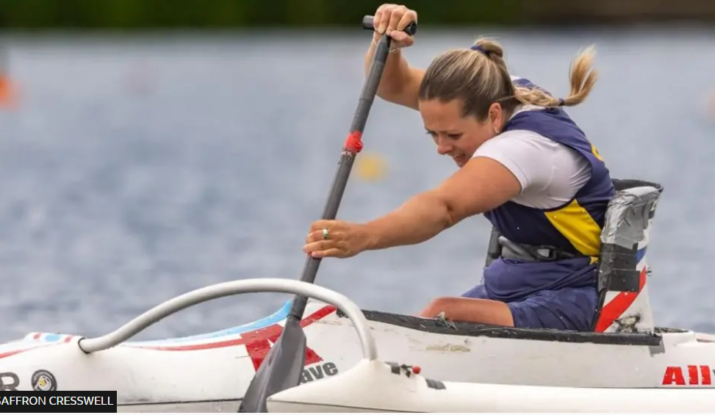
Saffron Cresswell was a young, talented international event rider who had a devastating fall at a horse trials a couple of years ago. She relied on one of our WashPod™ temporary disabled wetrooms to get home from hospital after the fall left her paralysed from the waist down.
But she’s in the news again for her remarkable transition from ‘Saddle to Paddle’ as she looks forward to competing at a top level again but this time for GB in canoeing.
“The WashPod™ allowed me to come home to my family and horses where I could continue my rehabilitation work and decide on what my future now held”.
“There were many things to think about, that I would never have considered before my accident. It’s all about getting to a point where you can live independently and having the WashPod™ certainly gave me a head start in feeling I could do things for myself.”
Saffron was positive about the future: “Life does not end with spinal cord injury” she said. “It is the beginning of a new life – a new normal life.”
Following her paralysis, she was determined not to allow her disability to define what she could achieve. Finding a new sense of purpose became an important part of her recovery, and she began exploring a range of adaptive sports, including wheelchair racing, tennis, skiing and waterskiing. She even completed two half marathons in her wheelchair last year.
Her experience highlights the importance of looking beyond the physical aspects of rehabilitation. For many people living with a life-changing injury or disability, being able to reconnect with activities, interests and social experiences that provide purpose can be an important part of rebuilding confidence and independence.
Then, in December, 18 months after her fall, she sat in a canoe for the first time.
“Canoeing’s been a huge breakthrough in me wanting to pursue a sport,” she said.
The technical nature of canoeing particularly appealed to her, providing a connection with her previous passion for horse riding.
“Canoeing’s a technical sport and coming from horse riding, which is also technical-based, was something I really thrived off.”
Her progression from the early stages of recovery to competing at a world championship demonstrates just how significantly a person’s expectations and opportunities can change when they are given the right support and access to appropriate activities.
Cresswell said that competing at a world championship would have been unimaginable during the early stages of her recovery. At that point, basic activities that many people take for granted had become significant challenges.
“Not being able to dress myself or go to the toilet or get out of bed or move was a huge thing to deal with,” she said.
Her story also illustrates why accessibility should be considered in terms of participation and quality of life, rather than simply physical access. Being able to get out of bed, use the bathroom independently, leave the house, work, socialise or participate in sport can all contribute to a person’s sense of identity, confidence and wellbeing.
Rather than focusing on the activities that her disability had made more difficult or prevented her from doing, she consciously chose to concentrate on what remained possible.
“I always say ‘think about the things you can do and not the things you can’t’,” she explained. “If I can live by that motto then it keeps me positive and enjoying my life.
“I see myself as lucky. I’m still in a position where I can come out, do sport, be outside, I work, I coach a lot of equestrian, I drive all over the country and I get to live a really fulfilled life.”
Her experience is a powerful reminder that successful rehabilitation is not simply about physical recovery. It is also about enabling people to regain control, maintain their identity and participate in the activities that make life meaningful.
For healthcare professionals, occupational therapists and those involved in designing accessible environments, this distinction is important. An adaptation that enables someone to wash independently, leave their home safely or return to an activity they value can have significance far beyond its practical function. It can help restore choice, dignity, confidence and independence—and ultimately support a more fulfilled life.
Dignity Access will be wishing her the best of luck at the World Para-Canoe Championships in Poland this weekend.