DESIGNING AESTHETICALLY FOR DISABILITY
When most people imagine a disabled bathroom, they picture something purely functional —
a stark, clinical space filled with plastic fixtures and cold stainless steel. But as
understanding of inclusive design evolves, so too must our expectations. Accessibility need
never come at the cost of comfort, style, or dignity.
This balance is beautifully realised in the story of David, a 69-year-old international
businessman diagnosed with Motor Neurone Disease (MND), who found in Dignity Access’s
WashPod™ to be a solution that was not just practical, but actually life-enhancing.
Combining Urgency with Innovation
When David received his MND diagnosis, his life changed overnight. The rapid progression
of the disease meant the family had to make swift decisions about how to adapt their home
— a Grade II listed property, where even minor changes required layers of permissions and
planning.
“For a listed building, there are normally so many hoops to jump through for any sort of
adaptations” David explained “Planning consent alone was going to be eight weeks — and
that’s before any building work. Given my deteriorating condition, I simply didn’t have the
time to wait.”
These last words encapsulate the reality for thousands of people facing sudden or
degenerative disability: the urgent need for accessible environments, without the burden of
bureaucracy or disruption.
That’s where the WashPod™ stood apart. As a temporary, pre-assembled wet room that can
be installed swiftly — often in a less than a day — it offered David a lifeline. Within just a
week of ordering, his new accessible bathroom was ready to use.
“It was literally plug in and go,” David said, marvelling at the simplicity. “And it can be
adjusted easily to meet any changes in my future needs.”
Challenging the ‘Institutional Look’ of Adaptations
At first, David’s family hesitated. Sister-in-law, Angela, who had discovered WashPod™
while researching accessible bathroom options for MND sufferers, recalled the family’s initial
reaction.
“Perhaps we were having to face what David would need, and fearing the WashPod™ would
look alien and low quality,” she said. “We even planned to disguise it behind freestanding
shelves.”
That hesitation is common — and revealing. Many families associate accessibility aids with a
loss of aesthetic harmony, fearing their homes will begin to resemble hospitals rather than
sanctuaries. It’s an understandable reaction: so much of the accessible equipment
historically available has prioritised function over form.
But when the WashPod™ was installed, those fears instantly dissolved.
“When it arrived, it quickly became clear that it was more beautiful than expected,” Angela
said. “Its position, on full view, was perfect.”
Far from being an intrusion, the WashPod™ became a feature piece — something the
family has admired and even celebrated. “David thoroughly enjoyed showing the space to his
friends and colleagues from around the world,” Angela shared.
Design that Honours Dignity
What made this experience so transformative wasn’t just the speed of installation or the
technical sophistication — it was the human-centred design behind every detail.
David’s wife, Jayne, described the installation as “exceptional.” She noted not only the
precision and care of the process but the empathy of the Dignity Access team.
“It was not just the speed of installation,” she said. “It was the kind demeanour of the team —
strangers coming into a space where a huge trauma is impacting the family. The lack of
noise and mess was hugely appreciated. The team showed exceptional sensitivity in their
words when talking about the WashPod™’s use and its future removal. Many won’t fully
appreciate how much this meant to us.”
That emotional intelligence — the understanding that accessibility is not just physical, but
psychological — is what sets great design apart from mere engineering. The WashPod™
design crafts something that not only solves a practical problem but also preserves a family’s
sense of home and humanity during life’s most challenging moments.
Accessible Design That Feels Like Home
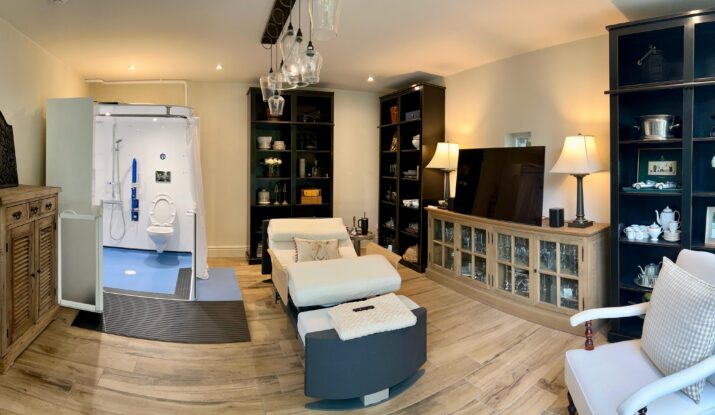
David’s WashPod™ could sit proudly in his downstairs living area, providing both
independence and elegance. The design blended seamlessly with the home’s classic
aesthetic, integrating functionality with style in a way that defies expectation.
“The WashPod™ has transformed everything,” Jayne shared. “David had more freedom with
a bathroom right by his bed. He was gleeful when visitors saw it and couldn’t wait to demo the
space — the fans, the lights. It looked very elegant and not at all out of place.”
For David, who had spent his career surrounded by good design, aesthetics were not
optional — they were essential. “He didn’t want his last years to look like he was living in a
hospital room,” Jayne explained. “The pod fitted beautifully with the décor. It was immaculately
designed and perfectly spaced inside for his changing needs. It fited so beautifully into a
modern bedroom, like an ensuite, without feeling like a disabled bathroom had arrived.”
The result was a space that reflects not disability, but dignity.
Aesthetics Are Not a Luxury
David’s story captures a fundamental truth often overlooked in accessible design: aesthetics
are not superficial — they’re integral to wellbeing.
For people living with disability or progressive illness, their environment becomes more than
just a backdrop; it becomes the stage for daily life, independence, and identity. A beautifully
designed space can foster emotional stability, confidence, and pride. Conversely, poorly
designed adaptations can reinforce feelings of loss or dependence.
By combining elegant design with accessibility, the WashPod™ challenges the false
dichotomy between function and form. It demonstrates that the two are — and must be —
inseparable.
Designing for Life, Not Just Need
What makes the WashPod™ particularly innovative is its adaptability. As a person’s
condition changes, so can the environment. WashPod™s are designed with modular
flexibility, allowing for adjustments without major renovation — an essential feature for
families navigating unpredictable changes in mobility. This is particularly true for children.
The needs of a baby are very different from a toddler and a teenager.
This ability to grow with the user reflects a broader philosophy: designing for life’s journey,
not just a moment in time.
Also, for those in rental properties, a WashPod can significantly open up the number of
suitable options available (as not many have accessible wetrooms), not only expediating the
speed with which a property can be found, but also allowing a greater selection at more
lucrative prices.
Additional, WashPod can stay with the client so that if they move, the WashPod can move
too! As a case manager said
As a Case Manager recently said, “what makes the WashPod the best solution is that my
client will always have access to accessible facilities in their own home which is
economically much more sensible than completing an accessible bathroom adaptation
everytime they move”.
Redefining Accessible Living
There is a growing movement to redefine how we think about accessible living. The best
adaptations today are discreet, elegant, and emotionally intelligent. They blend into the
home, enhancing quality of life without calling attention to disability.
In David’s case, the WashPod™ didn’t just make bathing easier; it gave him back a sense of
normalcy, privacy, and pride. It provided his family peace of mind and preserved the
architectural integrity of their listed home — all while offering a space that was, in Angela’s
words, “a beautiful addition.”
In the end, great design doesn’t need to shout “adaptation.” It simply whispers, “welcome
home.”
David’s son, Will, 27, is running the London Marathon in April 2026 and has just launched
his campaign to raise funds for Motor Neurone Disease in David’s name, to help others yet
to join them on this devastating path. Will invites you to donate any amount, however small,
as it will all have a huge impact.
https://2026tcslondonmarathon.enthuse.com/pf/will-morgan