Staying Independent at Home After a Stroke. Fast Access to Safe Bathing Can Make All the Difference
Every year, around 100,000 people in the UK experience a stroke, making it one of the leading causes of adult disability. While many people survive and go on to make significant recoveries, life after stroke often involves adapting to new physical, cognitive and emotional challenges.
For many people, the greatest milestone isn’t leaving hospital—it’s successfully returning home and remaining there. Independence, dignity and confidence are rebuilt one everyday activity at a time, and few daily tasks are as important, or as challenging, as washing and showering safely.
Accessible bathing facilities are frequently overlooked when planning discharge, yet they can be the deciding factor between returning home, remaining in hospital, moving into temporary residential rehabilitation, or experiencing avoidable readmission.
Why bathing becomes difficult after a stroke
Every stroke affects people differently, but common long-term effects include:
- Weakness or paralysis on one side of the body (hemiplegia)
- Poor balance and coordination
- Fatigue
- Reduced sensation
- Visual or perceptual problems
- Cognitive difficulties
- Communication problems (aphasia)
- Increased risk of falls
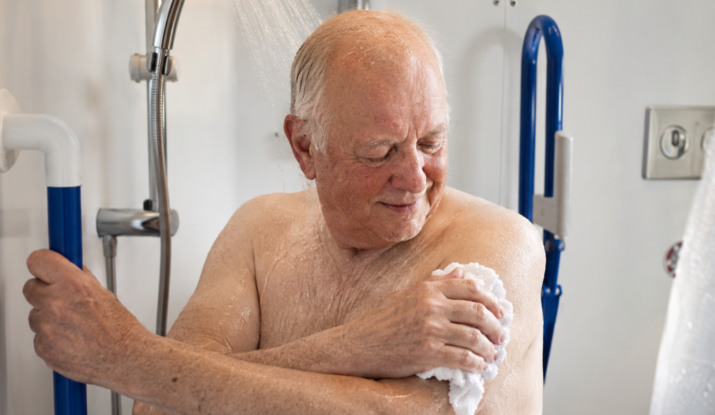
Bathrooms combine many hazards into one small space. Slippery floors, awkward transfers, stepping into baths and limited space can quickly turn a routine shower into one of the most dangerous activities in the home.
For someone recovering from a stroke, the fear of falling can become almost as disabling as the physical impairment itself. Many people begin avoiding showers altogether, relying instead on strip washes, assistance from carers, or simply going without.
The hidden impact of losing the ability to shower
The inability to bathe independently affects far more than personal hygiene. Research consistently shows that maintaining independence in activities of daily living contributes significantly to wellbeing, confidence and quality of life following stroke. Something as ordinary as taking a warm shower often represents normality. Regaining that simple routine can have profound psychological benefits.
Being unable to shower can lead to:
- Reduced self-esteem
- Loss of confidence
- Social isolation
- Anxiety
- Depression
- Reduced motivation during rehabilitation
- Greater dependence on carers
Home is usually the best place to recover
Modern stroke services increasingly recognise that recovery is often most effective within a person’s own home.
Familiar surroundings support:
- Greater independence
- Better orientation
- Increased confidence
- Improved participation in rehabilitation
- Family involvement
- Better mental wellbeing
However, this approach depends on the home being safe and functional. When bathrooms become barriers, discharge can be delayed despite the individual being medically fit to leave hospital.
The challenge of traditional adaptations
Conventional disabled wet room installations remain an excellent long-term solution for many households, but they are not always practical immediately after stroke.
Common barriers include:
- Long waiting lists
- Disabled Facilities Grant approval times
- Major building work
- Structural alterations
- Landlord refusal in rented accommodation
- Uncertainty about long-term recovery needs
Stroke recovery is often unpredictable. Some people regain mobility remarkably quickly, while others require permanent adaptations. Installing an expensive permanent wet room immediately may prove unnecessary, yet delaying any adaptation can leave people without safe washing facilities for months.
Temporary modular wet rooms offer a different approach
This is where modular temporary wet rooms such as the WashPod™ range from Dignity Access provide an alternative. Unlike traditional bathroom adaptations, WashPods™ are factory-built modular disabled wet rooms that can often be installed within a day rather than taking months.
Depending on the property and model selected, they can be positioned inside or outside the home with minimal disruption. Because they are designed as temporary or reusable adaptations, they are particularly suited to situations where needs may change.
Examples include:
- Early supported discharge after stroke
- Ongoing neurological rehabilitation
- Temporary wheelchair use
- Rented accommodation
- Listed buildings
- Homes awaiting permanent adaptations
- Emergency situations
Supporting rehabilitation rather than delaying it
One of the principles of stroke rehabilitation is encouraging people to do as much as possible independently.
An accessible shower allows individuals to practise:
- Safe transfers
- Standing balance
- Wheelchair manoeuvring
- Functional movement
- Personal care skills
Occupational Therapists (OTs) frequently describe bathing as one of the most meaningful activities to regain because it combines physical recovery with personal identity and dignity. When appropriate environmental adaptations are available early, rehabilitation can continue from day one at home rather than waiting months for building work.
Reducing pressure on families and carers
Stroke rarely affects just one person. Partners, spouses and adult children often become informal carers overnight. Assisting somebody into an inaccessible bath is physically demanding and potentially unsafe.
Providing level-access showering can reduce:
- Manual handling risks
- Carer fatigue
- Dependence
- Stress within the household
It also allows carers to support rather than perform every aspect of personal care, helping preserve independence wherever possible.
Flexible solutions for changing needs
Recovery after stroke is rarely linear. Equipment needed during the first three months may no longer be necessary after six months. Equally, some individuals may require greater support than initially expected. The modular nature of WashPod™ temporary wet rooms provides flexibility that conventional building work cannot always offer.
Some units can be removed once no longer required, while Dignity Access’s Turnaround Service for Local Authorities and Housing Associations supports refurbishment and reuse, aligning with Disabled Facilities Grant guidance encouraging recycling, sustainability and better value from public investment.
This flexibility allows clinicians to respond to current clinical need rather than trying to predict permanent requirements immediately after discharge.
A practical example
Imagine Margaret, aged 76.
Following a stroke, she is medically fit for discharge but now uses a wheelchair indoors and requires assistance transferring.
Her only bathroom is upstairs, with a traditional bath and no downstairs washing facilities. A permanent extension or wet room conversion could take several months. Without a suitable alternative, Margaret may remain in hospital unnecessarily or move temporarily into residential rehabilitation.
Instead, a modular WashPod™ can be installed within a day, providing a fully accessible level-access shower. Margaret returns home sooner, continues physiotherapy in familiar surroundings, maintains her daily routine and gradually regains confidence.
Six months later she is walking independently with a stick.
If the temporary wet room is no longer required, it can be removed and reused elsewhere.
The outcome is not only improved for Margaret—it also frees valuable hospital capacity and reduces overall costs to health and social care services.
Looking beyond the bathroom
Successful stroke rehabilitation is about far more than clinical treatment. It is about enabling people to resume everyday life with dignity, confidence and as much independence as possible. Safe access to washing facilities is one of the foundations that makes this possible.
As healthcare increasingly focuses on Home First principles, integrated care and reducing delayed hospital discharge, flexible housing adaptations have an increasingly important role to play.
Temporary disabled modular wet rooms such as the WashPod™ range demonstrate that not every accessibility solution needs to involve lengthy building work or permanent structural alteration. Sometimes, providing the right adaptation at the right time is enough to help someone leave hospital sooner, recover more effectively and remain living independently in the place they most want to be—their own home.
Image source: Header image generated using ChatGPT.