
Accessible Bathroom Design: Considerations for Occupational Therapists and the Role of Temporary Modular Wetrooms
The provision of accessible bathing facilities remains one of the most significant home assessments undertaken by Occupational Therapists (OTs) working in community rehabilitation, housing adaptations, social care and hospital discharge services.
Difficulties with toileting and personal hygiene are not only associated with increased care dependency and risk of falls, but are also recognised contributors to delayed discharge, carer strain, increased hospital re-admissions and avoidable admissions to residential care.
Accessible bathroom design should therefore be viewed not simply as a matter of regulatory compliance or equipment provision, but as a means of facilitating increased independence, maintaining dignity and supporting participation in daily life.
Assessment Before Adaptation
The design of any accessible bathroom should begin with a comprehensive occupational assessment rather than with assumptions regarding equipment or layout.
Key considerations include:
- Current and anticipated functional ability
- Transfer methods and mobility status
- The involvement of formal and informal carers
- Moving and handling requirements
- Cognitive and perceptual abilities
- Fatigue, pain and endurance
- Existing and future equipment needs
- The physical limitations of the property
The needs of an individual with a stable neurological condition may differ considerably from those of a person living with a progressive diagnosis or undergoing rehabilitation following acute illness or trauma.
Designing solely for current presentation can result in costly and disruptive re-
adaptations within relatively short timescales.
Occupational Therapists are therefore uniquely positioned to adopt an anticipatory approach that balances present function with likely future requirements.
Space as a clinical intervention
A common challenge within the UK’s housing stock is the limited size of existing bathrooms.
In many cases, standard bathrooms were not designed to accommodate wheelchairs,
shower chairs, hoists or carer assistance.
Insufficient circulation space can compromise both independence and safety by restricting transfer options and increasing manual handling risks.
Adequate space may be required for:
- Wheelchair manoeuvring and turning
- Side, front or angled transfers
- Assistance from one or more carers
- Mobile hoists or standing transfer aids
- Shower commodes and specialist seating
- Future ceiling track hoist installation
For many service users, level access wetrooms provide the greatest degree of flexibility
because they maximise usable floor area and eliminate barriers associated with enclosed shower cubicles or raised trays.
Level access and falls prevention
Bathrooms remain one of the highest-risk environments within the home for slips and falls due to the combination of water and smooth surfaces.
Good accessible design should include:
- Flush floor transitions
- Slip-resistant flooring
- Effective drainage design
- Appropriate lighting levels
- Colour contrast between fixtures and surfaces
- Thermostatically controlled water supplies
Level access showers remove trip hazards while facilitating access for wheelchair users and
individuals using wheeled shower commodes. Equally importantly, they improve working postures for carers and reduce the likelihood of unsafe compensatory techniques developing over time.
Supporting effective transfers
Toilet transfers are highly individual and often determine whether an individual can remain
independent in personal care.
The position of the toilet should consider:
- Preferred transfer direction.
- Available approach routes.
- Standing or pivot transfer techniques.
- Space for carer assistance.
- Grab rail positioning.
- Toilet height requirements.
Similarly, shower areas should support the individual’s preferred bathing method while preserving autonomy wherever possible. Height-adjustable fittings, fold-down shower seats and accessible controls can significantly increase independence for individuals with reduced
strength, balance or dexterity.
The importance of dignity and privacy during personal care should not be underestimated
and remains a central occupational outcome for many service users.
Responding to changing needs
OTs frequently work with individuals whose functional needs may change rapidly or
unpredictably. Progressive neurological conditions, complex rehabilitation pathways and palliative care can all create situations in which conventional adaptation pathways struggle to respond at sufficient speed.
Even where funding is approved promptly, major adaptations may involve lengthy assessment, design and construction processes.
In other cases, prognosis may remain uncertain, making permanent structural alterations difficult to justify at an early stage.
These situations have led to increasing interest in temporary and modular adaptation solutions.
Temporary modular wetrooms as an alternative option
Temporary modular wetrooms represent an additional intervention option where speed, flexibility or uncertainty are significant factors.
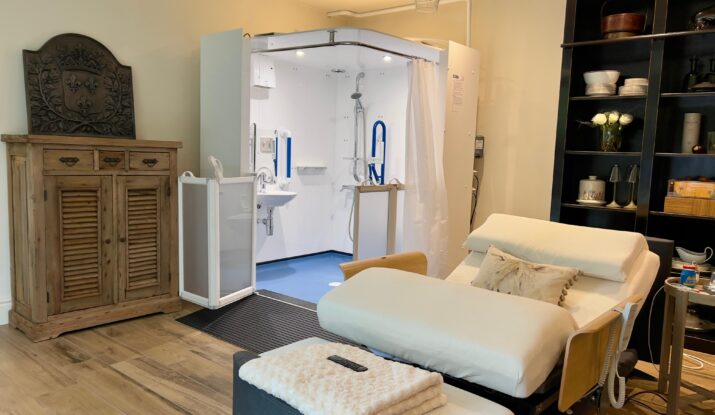
One example is the unique WashPod™ system developed by Dignity Access, which provides a fully accessible modular wetroom incorporating shower, toilet and basin facilities within a self-contained unit.
Unlike temporary bathing equipment or portable shower systems, modular wetrooms are designed to provide a complete level access environment that supports wheelchair use, assisted transfers and carer access while maintaining privacy and dignity.
The units can be rapidly installed either internally within existing accommodation or externally adjacent to the property, often with substantially less structural disruption than traditional building adaptations as they don’t require any major modifications.
Clinical situations where temporary provision may be beneficial
There are several circumstances in which OTs may consider temporary modular wetrooms as part of intervention planning.
Facilitating hospital discharge
Accessible bathing facilities are a frequent barrier to timely discharge following illness, injury or surgery.
Rapid provision of a suitable wetroom may support earlier return home while enabling
rehabilitation within the individual’s usual environment.
Delays to permanent adaptations
Waiting times associated with Disabled Facilities Grant processes and major building works can be considerable. Temporary provision may reduce dependence on bed bathing, strip washing or increased care packages while permanent solutions are progressed.
Progressive neurological conditions
For individuals living with conditions such as Motor Neurone Disease, Parkinson’s disease or Multiple Sclerosis, needs may evolve rapidly over relatively short periods. Temporary solutions may provide valuable flexibility while long-term requirements become clearer.
Rental accommodation
Extensive structural alterations may not be feasible within rented properties as Landlords
rarely want to modify their properties. Modular installations can offer an alternative where landlords can be confident that the property can be fully restored to its original state when the tenant moves on.
Palliative and end-of-life care
The ability to remain at home and maintain personal routines can be of considerable
importance during palliative care. Rapid access to appropriate washing facilities may support both dignity and family-centred care.
Short-term rehabilitation needs
Individuals recovering from trauma, orthopaedic surgery or major illness may experience
substantial but temporary disability. In such cases, permanent building work may not represent the most proportionate intervention.
Conclusion
Accessible bathroom design should be understood as an occupational intervention rather than solely an environmental modification. Well-designed facilities can improve independence, reduce manual handling risks, support carers and enhance quality of life.
While permanent adaptations remain the preferred solution for many individuals, OTs increasingly require flexible responses to changing clinical circumstances and housing
constraints.
Temporary modular wetrooms such as WashPod™ provide an additional option within the
adaptation pathway, particularly where rapid provision, uncertain prognosis or temporary
need make conventional approaches less suitable.
As pressures on health, housing and social care systems continue to grow, innovative
approaches that support timely discharge, rehabilitation and independent living are likely to
become increasingly relevant to OT practice.